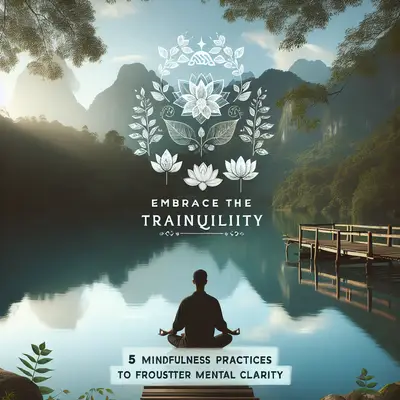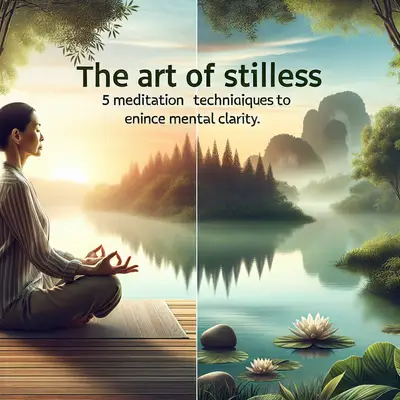
When the mind feels crowded and noisy, it can be tempting to fight with our thoughts or try to outrun them. Meditation offers a different approach: a quiet, steady turning toward ourselves. Instead of pushing away the noise, we create space around it. This space doesn’t erase our thoughts, but it makes them easier to understand, to hold, and eventually, to release.
This article explores how meditation can serve as a gentle reset—especially on days when everything feels too much. We’ll move through five simple mindfulness practices that support mental clarity without demanding perfection, special equipment, or large stretches of time. Think of them as soft invitations back to yourself, one small moment at a time.
Understanding Meditation As Mental Spaciousness
Meditation is often misunderstood as “stopping all thoughts” or “emptying the mind.” For most of us, that idea is both unrealistic and discouraging. A more helpful way to see meditation is as the practice of creating mental spaciousness: noticing what’s present without needing to fix it right away.
When you sit quietly—even for a minute—you begin to notice patterns: the same worry looping, the same story replaying, the same urge to distract yourself. Meditation doesn’t scold you for these patterns; it simply brings them into awareness so you can respond more gently and more clearly.
Over time, this steady act of noticing starts to shift the way you relate to your thoughts. Instead of being pulled into every mental storyline, you begin to sense a quiet vantage point underneath it all. From there, clarity doesn’t arrive as a sudden lightning bolt; it emerges more like a slow clearing of the sky after rain. You still have thoughts, but they move through more cleanly, leaving less residue behind.
Practice 1: The “Single Breath Check-In”
This first practice is simple enough to weave into even the most crowded day. Rather than committing to a long meditation session, you commit to one breath—fully felt, from start to finish. It’s less about duration and more about depth of attention.
- Pause wherever you are—at your desk, in a hallway, in your car (parked safely).
- Gently close your eyes if it feels comfortable, or soften your gaze.
- Notice your next inhale all the way in: the coolness at the nostrils, the gentle expansion of your chest or belly.
- Notice your next exhale all the way out: the warmth of the air, the slight softening of the shoulders, the feeling of letting go.
- At the end of the exhale, simply notice how you feel—without judging it.
This “single breath check-in” interrupts the automatic flow of the day. It’s a micro-meditation that reminds your nervous system that you are here, in this moment, not just inside the momentum of your thoughts. Practiced a few times throughout the day, it subtly clears mental clutter by reintroducing you to the simple fact of your own presence.
Practice 2: Noting Thoughts Like Passing Weather
When thoughts feel tangled, it’s easy to believe every single one. Meditation invites a softer stance: you learn to observe thoughts as events in the mind, rather than as instructions you must obey. One effective way to do this is through “noting.”
Here’s how to try it:
- Sit comfortably, with your back supported if you like.
- Let your eyes close or rest gently on a point in front of you.
- As thoughts arise, give them a simple label in your mind: “planning,” “remembering,” “worrying,” “judging,” “imagining.”
- After labeling, let the thought drift away on its own, returning your attention to the feeling of your breath.
- Repeat this for 5–10 minutes, moving at a relaxed pace.
Over time, this practice shifts your relationship to mental chatter. Instead of being swept away, you become like someone watching clouds from the ground—interested, but not grasping. The act of naming a thought creates a small distance between “you” and the content of your mind. That distance is where clarity lives: you can see the thought, consider it, and choose whether it deserves your attention or can be gently released.
Practice 3: Body Scan To Clear Cognitive Overload
When the mind is overworked, the body usually knows it first: tightness in the jaw, a subtle headache, a restless leg, a knot in the stomach. A body scan meditation brings awareness downward—out of the swirl of thought and into the simple sensations of being embodied. This often brings unexpected mental clarity, like setting down a heavy bag you forgot you were carrying.
To practice:
- Lie down or sit in a stable, comfortable position.
- Close your eyes and take two or three slow, natural breaths.
- Begin at the top of your head. Notice any sensations: tingling, warmth, tension, or neutrality.
- Move your attention slowly down: forehead, eyes, jaw, neck, shoulders, chest, arms, hands, torso, hips, legs, feet.
- At each area, silently name what you feel: “tight,” “warm,” “numb,” “neutral,” or simply “sensing.”
- Where there is tension, invite a gentle softening on the exhale, without forcing it.
This practice gives the mind a clear, structured task: feel, name, move on. That structure can calm mental noise by offering the brain a straightforward path to follow. When you finish, you might notice the mind feels a little quieter, not because the thoughts disappeared, but because your attention isn’t so tightly tangled in them.
Practice 4: Mindful Pausing Before Digital Overload
Many of us reach for a screen the moment there is a gap: in line at a store, waiting for a meeting to start, sitting alone at the table. These small gaps used to be moments of mental reset; now they often become additional sources of stimulation. A mindful pause before you open a device can protect a bit of mental clarity throughout the day.
Try this simple ritual:
- The next time you’re about to check your phone or open a new tab, pause with your hand still.
- Ask yourself quietly: “What am I looking for right now?” It might be distraction, connection, information, or just habit.
- Take three slow breaths before you proceed.
- If you still want to use the device, do so—just with a little more awareness.
This is meditation woven into everyday life: noticing the impulse, breathing with it, and then choosing consciously. Those three breaths won’t remove all digital overwhelm, but they create a tiny buffer between your attention and the constant pull of information. Over time, that buffer becomes a form of inner spaciousness, where clarity has room to appear.
Practice 5: Evening Reflection With Gentle Curiosity
At the end of the day, the mind often replays conversations, mistakes, and things left undone. Instead of fighting this, you can offer the mind a gentle container: a short, reflective meditation that acknowledges the day and then lets it rest.
You might try this before bed:
- Sit or lie down in a quiet space, with the lights low.
- Take a few easy breaths, letting your exhale be slightly longer than your inhale.
- Review your day slowly, like watching a soft, distant film.
- When a moment stands out—pleasant or difficult—silently say: “That happened. It’s okay to let it be.”
- If self-criticism arises, answer it with a simple phrase, such as: “I’m learning,” or “I did what I could with what I knew.”
- End by placing a hand on your chest or abdomen and saying, “The day is over. I can rest now.”
This practice promotes mental clarity by gently sorting through the day instead of carrying everything unresolved into the night. It doesn’t require you to solve every problem or perfect every action. It simply offers recognition and closure, which can soften mental tension and prepare the mind for more restorative sleep.
Conclusion
Meditation doesn’t have to be dramatic to be meaningful. Sometimes it’s as small as one fully felt breath, a quiet label placed on a wandering thought, or a pause before you open a new tab. These modest practices accumulate. Together, they create an inner environment that is a little less crowded, a little more spacious.
Mental clarity, in this sense, isn’t a single moment of enlightenment. It is the gradual, gentle uncurling of tension—mind and body remembering that they do not have to hold everything all at once. When thoughts feel loud, you have options beyond resisting or obeying them. You can sit with them, breathe with them, and let them pass through a mind that is learning, slowly and kindly, how to make room.
Sources
- National Center for Complementary and Integrative Health – Meditation and Mindfulness - Overview of meditation practices, potential benefits, and current research.
- American Psychological Association – Mindfulness Meditation: A Research-Proven Way to Reduce Stress - Summarizes psychological research on mindfulness and its effects on stress and cognition.
- Harvard Health Publishing – Mindfulness Meditation May Ease Anxiety and Mental Stress - Discusses evidence for mindfulness in reducing anxiety and improving mental well-being.
- Mayo Clinic – Meditation: A Simple, Fast Way to Reduce Stress - Practical explanation of meditation techniques and their role in stress reduction and mental clarity.
- UCLA Mindful Awareness Research Center - Offers research-backed resources and guided practices related to mindfulness and meditation.
Key Takeaway
The most important thing to remember from this article is that this information can change how you think about Meditation.