When life feels loud, it’s easy to treat meditation like another item on a growing to‑do list. Sit still, breathe, feel calmer, move on. But meditation can be something gentler and more meaningful: a quiet conversation with yourself that unfolds over time. Instead of forcing the mind to be blank, you learn to listen—to thoughts, to sensations, to what your body and heart have been trying to say underneath the noise.
In this space of listening, mental clarity isn’t a sudden breakthrough. It’s what slowly appears when you stop arguing with your own experience, and start befriending it.
Rethinking Meditation: Not Escape, But Honest Contact
Many people come to meditation hoping to escape their thoughts. When the mind refuses to cooperate, it’s easy to assume you’re “bad” at it. Yet from a contemplative perspective, an active mind isn’t a failure of meditation—it’s the raw material.
Meditation can be understood as a practice of honest contact: being with what’s here, without needing to fix it right away. Thoughts may race. The body may feel restless. Emotions may surface that you’d rather not see. Instead of trying to silence them, you give them space to exist without immediately reacting.
This shift from control to curiosity is where mental clarity begins. Clarity doesn’t mean having no thoughts; it means seeing them more clearly, and believing them less automatically. Over time, you start to notice patterns:
- the same worries looping in familiar ways
- the stories you tell yourself when you’re tired or stressed
- the physical signals that show up before emotional overwhelm
Meditation becomes less about creating a perfect inner state and more about building a caring, steady relationship with your own experience. From that relationship, decisions become simpler, priorities feel clearer, and the mind has room to breathe.
Creating a Soft Container for Practice
Before looking at specific practices, it helps to create a soft container—conditions that make it easier for meditation to support clarity rather than become another pressure.
Choose “small and honest” over “big and ideal.”
Five attentive minutes you actually do are more valuable than thirty minutes you dread. Start with a duration that feels almost too easy, and let it grow naturally if and when it wants to.
Let posture be supportive, not strict.
You don’t have to sit cross‑legged on the floor. A chair, sofa, or even lying down can work. The intention is simply to be both comfortable and awake—supported, but not slumping into sleepiness if possible.
Hold expectations lightly.
On some days, the mind may feel spacious. On others, it may feel tangled and noisy. Both are valid meditation days. Clarity develops more from consistency than from any single “deep” session.
End gently.
When the timer rings, pause for a few breaths before moving on. Notice how you feel, even if the answer is “not much different.” This teaches the mind that it can transition slowly rather than snapping back to urgency.
With this container in place, the following five mindfulness practices can help invite mental clarity in distinct but complementary ways.
Mindful Breathing: Returning to a Single, Simple Thing
Mindful breathing is often offered as an introduction to meditation, but it can also be a subtle, lifelong practice. Its power lies in its simplicity: the breath is always here, always moving, always available as a place to rest your attention.
How to practice
- Sit or lie down in a comfortable position.
- Gently close your eyes if that feels safe, or soften your gaze.
- Notice where you feel the breath most clearly—nostrils, chest, belly.
- Allow the breath to breathe itself. You don’t need to control it.
- With each inhale and exhale, silently note “breathing in” and “breathing out,” or simply “in” and “out.”
- When thoughts pull you away (and they will), notice that you’ve wandered and kindly guide attention back to the breath.
How this supports mental clarity
- It trains the mind to recognize when it’s wandered, without judgment.
- It offers a neutral anchor—something simple that isn’t emotionally charged.
- Over time, you notice that thoughts are like weather patterns moving through the sky of awareness. You can see them without becoming them.
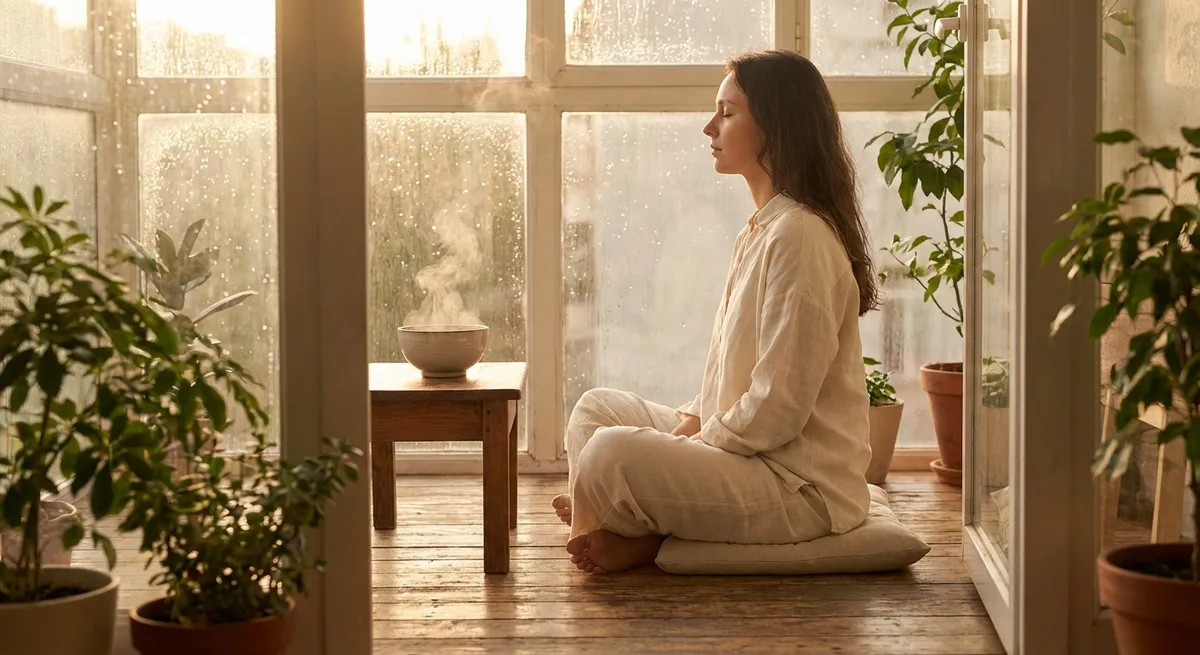
Even a few minutes of this practice can act like gently wiping condensation from a window: not removing what’s outside, but seeing it more clearly.
Body Sensing: Clearing Mental Fog Through Physical Awareness
When the mind feels cluttered, it’s often because we’ve been living mostly in our thoughts. The body holds a quieter kind of information: tension, fatigue, subtle signals that something needs attention. Body sensing (similar to a body scan, but less rigid) helps bridge the gap between mind and body.
How to practice
- Find a comfortable position, seated or lying down.
- Bring your attention to the contact points between your body and the surface supporting you. Feel the weight, the pressure, the warmth or coolness.
- Gently move your attention through the body in a loose, unhurried way—feet, legs, pelvis, abdomen, chest, hands, arms, shoulders, neck, face.
- At each region, notice any sensations: warmth, tightness, tingling, heaviness, ease, or even “nothing in particular.”
- If you find tension, you can breathe into that area, imagining the breath touching it. You don’t need to force it to relax; just acknowledge it.
- If the mind drifts to thinking about the body (“My shoulders are always tight; this is bad”), gently guide it back to direct sensation.
How this supports mental clarity
- It shifts attention from mental commentary to immediate experience.
- It reveals where stress is being held physically, which can clarify what’s really overwhelming you.
- It teaches that clarity isn’t only cognitive; it’s also felt in the body through a sense of groundedness and presence.
Often, after body sensing, thoughts feel less sticky. What felt like a single, heavy cloud of “I’m not okay” may separate into more discernible pieces—tiredness, worry, a tight jaw—each of which can be met more kindly.
Labeling Thoughts: Making Space Between You and Your Story
When thoughts are taken as absolute truth, the mind can feel like a crowded room with no exits. Mindful labeling (sometimes called “noting”) brings a bit of distance. Instead of being inside the thought, you recognize it as a mental event passing through awareness.
How to practice
- Sit comfortably and take a few gentle breaths.
- Allow your attention to rest wherever it naturally wants to—breath, body, or general awareness.
When a thought arises, lightly label it with a simple word or phrase, such as:
- “planning” - “remembering” - “worrying” - “judging” - “comparing” 4. After labeling, let the thought go if it wants to, and return to your chosen anchor or to open awareness. 5. If a thought stays, you don’t need to push it away. You can continue to notice, “worrying is here” or “planning is here,” without adding a story about it.
How this supports mental clarity
- It helps you notice recurring thought patterns, especially those that drain energy.
- It softens the identification with thoughts: “I am a failure” becomes “judging thought is here.”
- It opens a small but significant gap where choice can enter—do you want to follow that thought, or simply acknowledge it and let it pass?
Over time, labeling can reveal how much of mental fog comes from rehearsed narratives. Seeing them as repeatable patterns, rather than facts, is often the beginning of clearer perception.
Single-Task Attention: Turning Everyday Moments Into Practice
Meditation doesn’t have to be limited to a cushion or specific time of day. One of the most accessible ways to invite mental clarity is to choose a simple daily activity and do it with full attention, as if it were the only thing that mattered for those few minutes.
How to practice
- Pick an everyday task: making tea, washing dishes, brushing your teeth, walking to the mailbox.
- Commit to doing this one activity with mindful attention today.
While you’re doing it, gently gather your awareness around the direct experience:
- the temperature of the water - the texture of the mug or toothbrush - the rhythm of your steps - the sounds and smells around you 4. When your mind wanders into plans, worries, or commentary, notice it and note, “thinking,” then bring attention back to the task. 5. When you finish, pause for a breath or two and notice how you feel before moving on.
How this supports mental clarity
- It offers brief but frequent resets throughout the day, preventing mental clutter from accumulating unnoticed.
- It demonstrates that clarity doesn’t require special conditions; it can arise in ordinary movements.
- It trains the habit of doing one thing at a time, which directly counters the mental scattering that comes from constant multitasking.
As this becomes familiar, you may find that you naturally bring more presence into other parts of your day—conversations, work, rest—creating more continuity and less fragmentation.
Gentle Reflection: Letting Insights Emerge, Not Forcing Them
Meditation can sometimes feel incomplete if we stand up immediately afterward and plunge back into busyness. A short, gentle reflection at the end of practice can help integrate what you’ve noticed and let clarity crystallize in a natural way.
This is not about analyzing every moment of the session. It’s more like quietly asking, “What wants to be remembered from this?” and listening for a simple response.
How to practice
- At the end of your meditation, stay seated for an extra minute or two.
- Place a hand on your heart or belly, if that feels comfortable.
Ask yourself softly:
- “What did I notice today?” - “How is my body right now?” - “Is there one small kindness I can offer myself for the rest of the day?” 4. Listen without forcing an answer. If nothing clear comes, that’s fine. The question itself can be enough. 5. If you like, jot down a single sentence or phrase in a notebook—something like, “Mind was busy, but I stayed,” or “Shoulders were tight; I need rest.”
How this supports mental clarity
- It translates subtle internal experiences into simple, understandable insights.
- It encourages self-kindness rather than self-judgment about how the session went.
- It helps you notice gradual shifts over time, which can be grounding when daily life feels chaotic.
In this way, meditation becomes not just a state you enter, but a source of gentle guidance that accompanies you as you move through your day.
Conclusion
Meditation doesn’t have to be dramatic to be meaningful. The practices of mindful breathing, body sensing, labeling thoughts, single-task attention, and gentle reflection are modest in appearance, yet quietly powerful over time. Each one invites you to relate to your mind differently—not as a problem to be fixed, but as a landscape to be understood and cared for.
Mental clarity rarely arrives all at once. More often, it unfolds in small shifts: a bit more space around a familiar worry, a moment of choice where there used to be only habit, a day when you realize you are speaking to yourself a little more kindly. These are subtle changes, but they add up.
As you explore these practices, you don’t need to do them all, or do them perfectly. Choose one that feels approachable, meet it with patience, and let your inner conversation evolve at its own pace. In that gentle listening, a quieter, clearer mind often begins to find you.
Sources
- [National Center for Complementary and Integrative Health (NCCIH) – Meditation: In Depth](https://www.nccih.nih.gov/health/meditation-in-depth) - Overview of meditation types, potential benefits, and what research currently shows
- [American Psychological Association – Mindfulness Meditation: A Research-Proven Way to Reduce Stress](https://www.apa.org/topics/mindfulness/meditation) - Summarizes psychological research on mindfulness practices and their effects on stress and well‑being
- [Harvard Health Publishing – Mindfulness Meditation May Ease Anxiety, Mental Stress](https://www.health.harvard.edu/mind-and-mood/mindfulness-meditation-may-ease-anxiety-mental-stress) - Discusses evidence-based benefits of mindfulness meditation on mental health
- [Mayo Clinic – Meditation: A Simple, Fast Way to Reduce Stress](https://www.mayoclinic.org/tests-procedures/meditation/in-depth/meditation/art-20045858) - Practical guidance on how to begin meditating and how it supports stress reduction
- [UCLA Mindful Awareness Research Center – Free Guided Meditations](https://www.uclahealth.org/programs/marc/mindful-meditations) - Provides guided audio practices aligned with the kinds of mindfulness techniques described in this article
Key Takeaway
The most important thing to remember from this article is that this information can change how you think about Meditation.