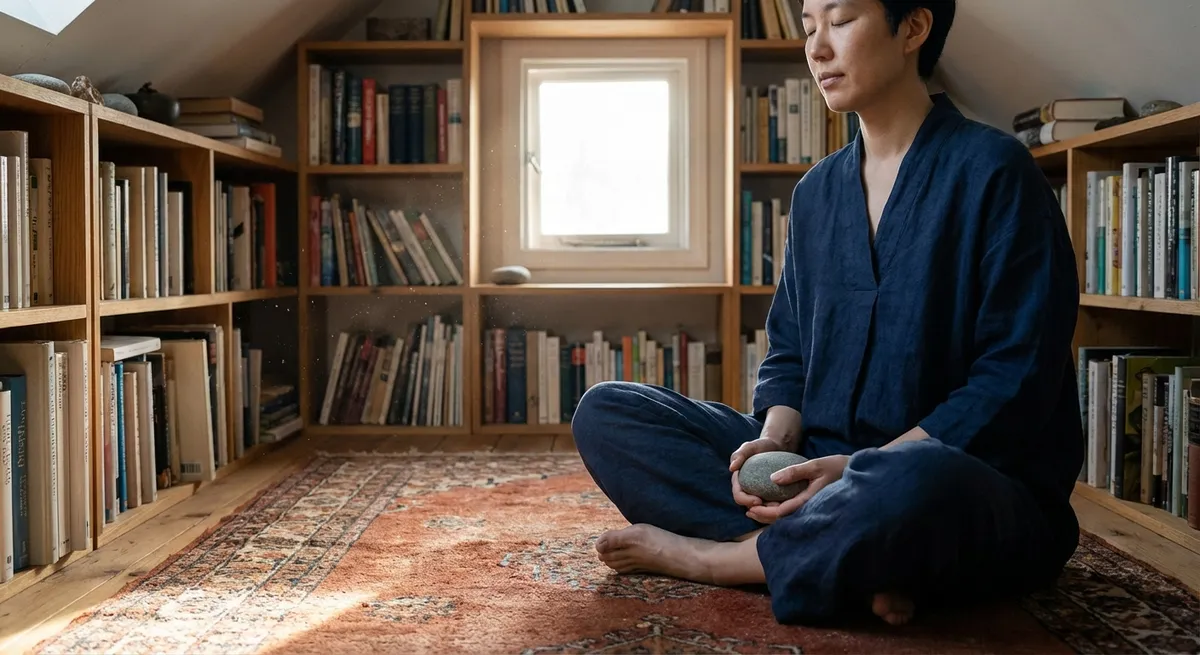
There is a moment—often just a breath long—when the noise around you softens. It might be when you first wake up, when you pause between messages, or when you exhale after a long day. Meditation lives in that kind of moment: ordinary, quiet, and surprisingly spacious. You don’t need special techniques or perfect focus to begin. You only need a willingness to sit with yourself as you are, and to notice what happens when you do.
This gentle noticing is where mental clarity begins. Not as a sudden flash of insight, but as a slow, steady clearing of space inside your own mind.
Meditation as a Soft Place to Land
Meditation is often presented as a way to “fix” stress, anxiety, or scattered thoughts. But it can be more supportive to see it as a soft place to land—a regular return to yourself, without judgment or performance.
When you meditate, you are not trying to become someone different. You are learning to relate differently to what is already here: your thoughts, your emotions, your physical sensations. Instead of being pulled into every story your mind tells, you practice sitting beside those stories, observing them with curiosity. This simple shift—from being inside every thought to watching thoughts come and go—opens a surprising amount of inner room.
Mental clarity grows from this room. As you practice, you may notice that:
- You recognize unhelpful thought patterns sooner.
- You feel a slight pause before reacting.
- You can hold discomfort without immediately needing to escape it.
- Your decisions feel a little more grounded and less rushed.
None of this has to happen quickly or dramatically. Meditation is more like tending a garden than flipping a switch: small, consistent care gradually changes the landscape.
Creating a Gentle Container for Practice
Before exploring specific mindfulness practices, it helps to create a simple container for your meditation time—something steady but flexible.
You might begin by choosing:
- A small amount of time. Even 5 minutes is enough. Consistency matters more than duration.
- A regular space. A chair by a window, a corner of your bed, or a quiet spot on the floor can become a cue that it’s time to turn inward.
- A realistic intention. Instead of “I will clear my mind,” you might choose “I will sit and notice,” or “I will be present with whatever arises.”
It can also help to release expectations. Some days will feel scattered. Some will feel settled. Both are part of the practice. Meditation is not a performance to be graded; it’s a relationship you build with your own attention.
With that container in place, the following five mindfulness practices can gently support mental clarity—offering different ways to settle, observe, and soften the mental clutter that accumulates through the day.
Practice 1: Slow Breathing as an Anchor
The breath is often the first place we turn in meditation because it is always with us and always moving. Using the breath as an anchor doesn’t mean forcing it to be deep or perfect. It means allowing yourself to rest your attention on something simple and rhythmic.
You might try this:
- Sit or lie down in a comfortable position, letting your spine be as relaxed and upright as feels natural.
- Gently close your eyes, or lower your gaze to a point in front of you.
- Notice where you feel the breath most clearly—at the nostrils, chest, or belly.
- Allow your breath to slow slightly, without strain. Perhaps inhaling to a count of four, and exhaling to a count of six.
- Each time your mind wanders (and it will), softly notice where it went, and then escort your attention back to the feeling of the breath.
The clarity in this practice doesn’t come from eliminating thoughts, but from repeatedly choosing where to place your attention. Over time, it becomes easier to notice when your mind has drifted into worry or rumination and to return to a steadier place within yourself.
Practice 2: Gentle Body Awareness to Quiet Mental Noise
Thoughts often feel loudest when we are mostly in our heads. Bringing attention into the body can invite a different kind of presence—quieter, more grounded, and less entangled in mental stories.
A gentle body awareness practice might look like this:
- Sit or lie down comfortably, allowing your body to be supported.
- Begin at the top of your head and slowly move your attention downward, region by region: face, neck, shoulders, arms, chest, back, abdomen, hips, legs, and feet.
- In each area, simply notice what is present: warmth or coolness, tightness, tingling, heaviness, or perhaps very little sensation at all.
- When you encounter tension, you can soften slightly around it, as if creating more space for that sensation to exist without needing to push it away.
- If your mind wanders into stories (“My shoulders are tight because of that email…”), kindly acknowledge the thought and return to the raw sensation.
This practice supports mental clarity by shifting you out of repetitive thinking and into direct experience. Instead of looping through the same concerns, you are training your attention to rest in what is actually happening right now. That simple shift can make your inner world feel less crowded and more spacious.
Practice 3: Observing Thoughts Like Passing Weather
One of the gentlest ways to clear mental clutter is to change how you relate to your thoughts. Rather than treating them as commands or facts, you can begin to see them as mental events—transient, shifting, often repeating, but not necessarily true or urgent.
To explore this:
- Sit quietly and allow your mind to do what it naturally does: think. You are not trying to stop thoughts.
- As a thought arises, silently label it in a light, friendly way. For example: “planning,” “worrying,” “remembering,” “judging,” “imagining.”
- Notice how the thought feels in your body. Does your jaw tighten? Does your breathing change?
- Watch how the thought eventually fades or is replaced by another, without you needing to do anything.
- If you become absorbed in a chain of thoughts, gently recognize, “Ah, I was lost in thinking,” and return to a neutral focus like the breath.
Seeing thoughts as passing weather patterns—clouds, wind, shifting light—offers a sense of spaciousness. The mind may still produce storms, but you are less likely to feel trapped inside them. This perspective naturally supports clearer thinking, because you are less entangled in every mental narrative.
Practice 4: One-Task Presence in Everyday Moments
Mental clutter often intensifies when we are half-attending to many things at once. A simple way to cultivate clarity is to choose, briefly, to be with just one task—fully, quietly, without rushing.
You might experiment with:
- Mindful drinking. When you have a glass of water or tea, pause. Feel the temperature of the cup, notice the scent, and follow the sensation of each sip from mouth to throat.
- Mindful transitions. Before opening a new tab, joining a call, or entering a room, take one slow, conscious breath and feel your feet on the floor.
- Mindful walking. As you move from one space to another, bring attention to the contact of your feet with the ground and the steady rhythm of your steps.
Choose just one of these to practice each day. The goal is not perfection, but sincerity—a genuine attempt to be where you are, doing what you are doing.
Over time, this one-task presence can spill into more complex parts of your life. You may notice that you can think more clearly when you are not asking your mind to hold too many threads at once.
Practice 5: Evening Reflection to Gently Clear the Day
Mental clarity is also supported by how we close the day. When experiences pile up without reflection, they can linger as background tension. A brief, kind review of the day can help your mind set some of that down.
You might try an evening reflection like this:
- Sit or lie down in a quiet place, perhaps just before bed.
- Recall your day gently, from morning to evening, as if watching a calm, simple movie.
- Notice three moments that felt nourishing, even in small ways: a kind word, a short walk, a moment of relief. Acknowledge them.
- Notice any moments of difficulty or tension. Rather than analyzing them, simply recognize: “That was hard,” or “That felt heavy.” Offer yourself a brief phrase of kindness, such as, “It makes sense that this was challenging.”
- Conclude with one slow, deliberate breath, imagining the day settling behind you, and giving yourself permission to rest.
This kind of reflection doesn’t erase problems or force positivity. Instead, it gathers the day into a clearer shape, so that your mind is not left holding a tangle of unprocessed moments. Over time, it can create a greater sense of inner order and emotional clarity.
Conclusion
Meditation does not ask you to become unshakably calm or endlessly focused. It simply invites you to meet your experience with a little more gentleness and curiosity, moment by moment. The practices of slow breathing, body awareness, observing thoughts, one-task presence, and evening reflection are all different doorways into the same quiet room inside you.
Mental clarity grows in that room not because life becomes simple, but because you are no longer swept away by every passing thought or feeling. You begin to sense a steadier self underneath the noise—a presence that can listen, choose, and respond with more ease.
You do not need to master these practices. Just begin, in small, honest ways. One breath. One moment of noticing. One quiet pause in the middle of your day. Over time, these small acts of attention can gently reshape the inner landscape you live in every day.
Sources
- National Center for Complementary and Integrative Health – Meditation: In Depth – Overview of different meditation practices, potential benefits, and research findings
- American Psychological Association – Mindfulness Meditation: A Research-Proven Way to Reduce Stress – Summarizes psychological research on mindfulness and its effects on stress, attention, and emotional regulation
- Harvard Health Publishing – Mindfulness Meditation May Ease Anxiety, Mental Stress – Discusses how mindfulness practices support mental well-being and clarity
- Mayo Clinic – Meditation: A Simple, Fast Way to Reduce Stress – Explains practical aspects of starting a meditation practice and its impact on mental health
- Headspace – What is Mindfulness Meditation? – Provides accessible explanations and examples of everyday mindfulness practices
Key Takeaway
The most important thing to remember from this article is that this information can change how you think about Meditation.