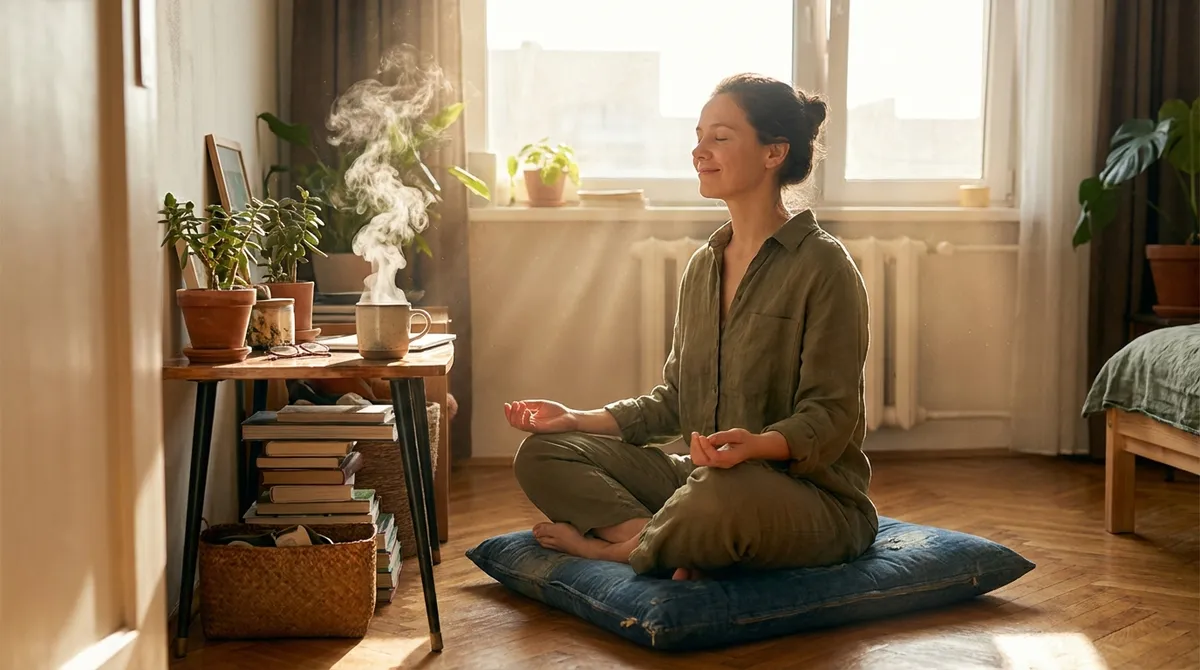
There are days when thoughts feel like they’re moving faster than you can track them—tabs open in the mind, all requesting attention at once. Meditation doesn’t erase that noise, but it can soften the edges and help you remember that there is a quiet place beneath it all. When we approach meditation gently, as a way of drifting back to our center rather than forcing stillness, clarity begins to return almost on its own.
This guide explores how meditation can act as a calm reset button for the mind, and offers five mindfulness practices that invite mental clarity without pressure or perfectionism.
Returning To Yourself, One Breath At A Time
Meditation is often imagined as a perfectly still person, eyes closed, thoughts completely quiet. In reality, most of us experience it as a series of tiny returns—wandering off in thought, noticing, and coming back to the present. That “coming back” is the heart of the practice, and it’s where clarity slowly begins to grow.
Each time you notice your attention has drifted and gently guide it back to your breath, your body, or the present moment, you’re strengthening the part of your mind that can observe rather than react. Over time, that observing quality becomes more available in everyday moments: during a hard conversation, a stressful email, or a restless night.
Meditation doesn’t require special beliefs or elaborate rituals. It begins with a simple willingness to pause and be with what’s already here—without immediately trying to fix it. That pause creates a small space between stimulus and response, and in that space, clearer choices become possible.
As you explore the practices below, it can help to release any expectations of “doing it right.” The mind will wander. Emotions will surface. Sensations will change. Your only job is to notice, soften around what you find, and return—over and over—to what anchors you in the moment.
Practice 1: Soft-Gaze Breath Awareness
This practice invites calm without requiring you to close your eyes. It can be especially helpful when you feel mentally crowded but still need to move through your day.
Sit or stand in a comfortable position and let your gaze rest softly on a neutral point—a wall, a window, or the space in front of you. Allow your eyes to be slightly unfocused, as if you’re looking through what’s in front of you rather than at it. Without changing your breathing at first, simply notice: where in your body do you feel the breath the most clearly? It might be your nostrils, your chest, or your abdomen.
As you inhale, mentally whisper “in.” As you exhale, mentally whisper “out.” Let the rhythm be natural, not forced. When thoughts come—and they will—acknowledge them like distant voices in another room, and then gently return your attention to the feeling of breathing. You’re not trying to block thoughts; you’re letting them pass through the background while your focus rests in the foreground.
Even two or three minutes practiced this way can bring a sense of quiet order to the mind. Over time, you may notice that this soft-gaze awareness begins to arise on its own in moments of stress, giving you just enough space to respond with more clarity and less urgency.
Practice 2: Body Scan For Clearing Mental Static
Mental fog often has a physical counterpart: tight shoulders, a clenched jaw, a buzzing behind the eyes. A body scan meditation helps you notice where your body is holding that static, so it can gently unwind.
Lie down or sit in a supported position, allowing your hands to rest wherever they feel natural. Close your eyes if that feels comfortable, or keep a soft gaze. Start at the crown of your head, simply observing sensations: warmth, coolness, tension, tingling, or even an absence of sensation. There’s no need to label anything as good or bad; you’re just noticing.
Slowly move your attention down—forehead, eyes, jaw, neck, shoulders, chest, back, arms, hands, abdomen, hips, legs, and feet. At each point, pause for a few breaths. If you notice tightness, imagine your breath flowing in and out of that area, bringing a little more ease with each exhale. You’re not forcing relaxation; you’re offering your attention and allowing the body to respond in its own time.
This quiet tour of your body often reveals subtle pockets of tension you didn’t realize were there. By softening into these areas, the nervous system can shift out of constant alert mode. As your body settles, mental static often begins to thin, revealing a clearer, steadier mind beneath it.
Practice 3: Single-Task Mindfulness
Much of our mental clutter comes from trying to do several things at once—scrolling, replying, thinking ahead, all in a single moment. Single-task mindfulness is a way of reclaiming your attention and giving it one safe place to rest.
Choose any simple, everyday activity: washing a cup, making tea, brushing your hair, or opening the curtains in the morning. For the next few minutes, let that be the only thing you do. Notice the sensations involved—temperature, texture, sound, movement. If you’re washing a cup, feel the water on your hands, the weight of the cup, the sound of the water running. If you’re making tea, notice the scent of the leaves, the warmth of the mug, the color of the liquid.
When your mind jumps to other tasks, gently guide it back to what your hands are doing right now. There’s no frustration needed; each return is part of the practice. You’re training your attention to stay with one thread, rather than fraying across many at once.
Over days and weeks, you may find that this way of being—fully with one thing at a time—starts to spread into other areas: listening more deeply in conversations, working with more focus, or even resting more completely when you take a break. Mental clarity often emerges not from doing more, but from doing one thing at a time with your full presence.
Practice 4: Labeling Thoughts With Kindness
Sometimes clarity is blocked not by the number of thoughts, but by how entangled we feel in them. A simple labeling practice can help you step back just enough to see thoughts as events in the mind, rather than as absolute truths.
Find a quiet place to sit for a few minutes. Let your body settle and bring your awareness to your breath for a short while. Then, begin to notice thoughts as they arise. Instead of following each thought’s storyline, gently give it a simple label, such as “planning,” “remembering,” “worrying,” “judging,” or “imagining.”
For example, if you notice yourself replaying a conversation, you might quietly label it “remembering.” If your mind jumps to your to-do list, you might label it “planning.” There’s no need to choose perfect labels; they’re just light touchpoints that help you recognize what’s happening.
The key is to do this with kindness, not criticism. You’re not trying to stop thinking; you’re practicing recognizing thinking as thinking. After labeling, softly return to your anchor—your breath, the feeling of your feet on the floor, or the sounds in the room.
With repetition, this practice can create more inner space. Thoughts that once felt overwhelming become easier to see from a slight distance. In that space, you can sense which thoughts are actually helpful and which can be allowed to pass, leaving more room for clarity and calm.
Practice 5: Evening Reflection For Gentle Mental Clearing
The mind often feels busiest just as we’re trying to rest. An evening meditation that pairs reflection with release can help you clear some mental clutter before sleep, making room for a softer night and a clearer morning.
Sit or lie down in a comfortable position, with a notebook nearby if you like. Begin by taking a few slow, steady breaths, allowing the body to know that the day is winding down. Then, gently review your day in your mind—almost like watching a quiet slideshow. Notice moments that felt meaningful, stressful, or simply ordinary.
If certain thoughts or worries repeat, you can choose to write them down—almost as if you’re placing them in a safe container for the night. You’re not solving them; you’re acknowledging them and setting them aside with the understanding that you can return to them tomorrow with fresher eyes.
After a few minutes of reflection, shift your focus to three small things you’re grateful for or simply appreciate from the day—a kind message, a good stretch of sunlight, a meal you enjoyed. Let yourself rest with each one for a few breaths. This isn’t about forcing positivity; it’s about balancing the mind’s natural pull toward what’s unfinished with a gentle recognition of what was quietly good.
End the practice by returning to your breath or to the feeling of your body supported by the bed or chair. Imagine the events of the day gently dissolving, leaving you with a little more space, a little more quiet, and the sense that you can begin again tomorrow with a clearer mind.
Conclusion
Meditation isn’t about escaping your life; it’s about meeting it with clearer eyes and a softer heart. Each of these practices—soft-gaze breathing, body scanning, single-task mindfulness, thought labeling, and evening reflection—offers a different doorway into the same quiet room inside you.
You don’t need to practice them all at once or perfectly. Even a few minutes of intentional awareness can begin to untangle mental knots and remind you that beneath the noise, there is a steadier place you can return to. Over time, these gentle returns to the present moment add up, forming a subtle but reliable path back to your own center, whenever you need it.
Sources
- National Center for Complementary and Integrative Health – Meditation: In Depth – Overview of meditation practices, potential benefits, and research findings
- American Psychological Association – Mindfulness Meditation: A Research-Proven Way To Reduce Stress – Discusses evidence-based effects of mindfulness on stress, attention, and emotional regulation
- Mayo Clinic – Meditation: A Simple, Fast Way To Reduce Stress – Explains different types of meditation and practical tips for getting started
- Harvard Health Publishing – Mindfulness Meditation May Ease Anxiety, Mental Stress – Summarizes research on how mindfulness practices can support mental health and clarity
- UCLA Mindful Awareness Research Center – Free Guided Meditations – Provides guided audio practices that align with the techniques described above
Key Takeaway
The most important thing to remember from this article is that this information can change how you think about Meditation.