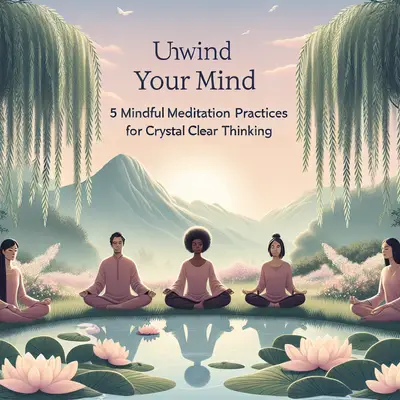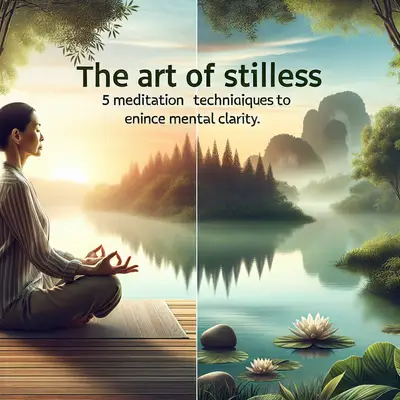
When life feels dense and overfull, it’s often not our schedule that hurts most—it’s the way our thoughts crowd together. Meditation and mindfulness don’t remove responsibilities, but they can create a gentle sense of “breathing room” around them. Instead of pushing thoughts away or trying to control every feeling, we learn to sit beside our experience with a bit more kindness and a bit more space.
This quiet mental space isn’t dramatic. It’s often subtle—a slightly slower breath, a softer reaction, a moment of choice before we speak or act. Over time, these small pauses add up to a clearer, steadier inner landscape.
Below are five mindfulness practices that support mental clarity. They are simple, not flashy. Think of them as ways to tidy the inner desk, one small movement at a time.
Understanding Mental Clarity as Spaciousness, Not Perfection
Many people imagine mental clarity as a spotless, thought-free mind. In reality, clarity often looks more like a room where everything is visible and nothing is hidden under a frantic pile. Thoughts still come and go, but they are easier to see, and they feel less like emergencies.
Meditation supports this by changing our relationship with thinking rather than eliminating it. Through practice, we start to notice three important shifts:
- From fusion to observation: Instead of being inside every thought, we begin to watch thoughts arise, stay for a while, and pass.
- From urgency to curiosity: Not every idea or worry demands immediate action; some simply ask to be noticed.
- From tightness to roominess: Even in stress, we may feel a thin layer of space—like a window cracked open in a stuffy room.
Mental clarity is less about having no thoughts and more about recognizing, “This is what my mind is doing right now,” without instantly believing or obeying every mental impulse. Meditation gives us a gentle, repeatable way to practice this skill.
Practice 1: Anchor on the Exhale
Using the breath as an anchor is a familiar idea, but placing special attention on the exhale can help the mind settle and simplify. The out-breath naturally activates the body’s relaxation response, which can support clearer thinking.
How to practice:
- Sit or lie down in a comfortable position, letting your spine lengthen without strain.
- Close your eyes or lower your gaze. Notice the simple fact that you are breathing.
- Allow the inhale to come on its own. On the exhale, gently place your attention there—following the breath out of the body.
- You might silently say “out” or “soften” on each exhale, if that feels supportive.
- When the mind wanders (and it will), kindly note “thinking” and return to the feeling of the exhale.
- Stay with this for 5–10 minutes.
Focusing on the exhale doesn’t force peace, but it can create a subtle downward shift from mental agitation toward steadiness. Over time, the body begins to recognize this pattern as a cue to ease, making it easier to access mental clarity during the day.
Practice 2: Labeling Thoughts with Gentle Words
When the mind is busy, it can feel like we are tangled in a web of thought. Softly labeling what’s happening—without judgment—can help untangle that web and turn chaos into something more understandable.
How to practice:
- Sit quietly for a few minutes with your eyes open or closed. Let the mind do what it does.
Whenever you notice a thought, gently give it a simple label, such as:
- “Planning” - “Remembering” - “Worrying” - “Judging” - “Imagining” 3. Use the same calm tone of voice internally, as if observing the weather: “Planning… remembering… worrying.” 4. After labeling, return briefly to the breath or the feeling of your body sitting. 5. Continue this for 5–15 minutes.
Labeling doesn’t stop the thinking process, but it creates a small, clear step back from it. Instead of “I am anxious,” the experience becomes “Anxious thinking is happening.” That small shift in language can open up perspective and reduce the sense of being overwhelmed by thoughts.
Practice 3: The Single-Task Mindful Minute
Much of mental fog comes from frequent task-switching. A single minute of wholehearted presence can act like a small clearing in the day. This practice asks you to do one simple activity with full attention, as if it were the only thing that exists for a short while.
How to practice:
- Choose an ordinary activity: sipping water, washing your hands, opening a window, or stretching your arms.
- For one full minute, give yourself completely to that activity. For example, if you’re washing your hands, notice:
- The temperature and texture of the water
- The feel of your hands touching
- The scent of the soap
- The sound of the water running
- When your mind jumps to something else, gently bring it back to the direct sensation of what you’re doing.
- When the minute is over, pause and take one conscious breath before moving on.
This tiny practice can be woven into your day many times, no special setting required. Each mindful minute is like a quick clearing of the mental windshield, restoring a small but noticeable clarity.
Practice 4: Body Scan as a Way to Set Thoughts Down
When the mind is crowded, moving attention from the head into the body can be deeply settling. A body scan helps by inviting awareness into physical sensations, which are usually simpler and more concrete than thoughts.
How to practice:
- Lie down or sit comfortably with your spine supported. If you can, close your eyes.
- Take a few slow breaths, then bring attention to the top of your head. Notice any sensations: tingling, warmth, pressure, or even numbness.
- Gradually move attention down through your body: face, neck, shoulders, arms, chest, back, abdomen, hips, legs, and feet.
- At each area, silently note what is present: “tight,” “warm,” “neutral,” “heavy,” or “no clear sensation.”
- If you encounter tension, you might invite a softening on the exhale, but don’t force anything. Allow the body simply to be as it is.
- When the mind wanders, gently return it to the area of the body you were exploring.
A body scan is like setting down a stack of mental papers and feeling the solidity of the desk beneath your hands. By shifting attention from mental narratives to physical presence, the mind often becomes less tangled and more open.
Practice 5: Evening “Mental Shelf” Reflection
At the end of the day, thoughts can swirl: unfinished tasks, conversations replayed, worries about tomorrow. This simple reflection practice invites you to lay things out clearly, as if placing them on a shelf—some to hold, some to release for now.
How to practice:
- Sit quietly in the evening, perhaps with a notebook, for 5–10 minutes.
Take a few slow breaths and gently ask: “What is still occupying my mind right now?”
3. Without rushing, list or mentally note what shows up: tasks, concerns, feelings, questions.
For each one, ask a calm follow-up:
- “Is there a small, concrete step I can take tomorrow?” - “Do I need to think about this now, or can I revisit it later?” 5. If it can wait, imagine placing it gently on a mental shelf labeled “Tomorrow” or “Later.” You’re not denying it; you’re giving it a home. 6. End with three slow breaths, noticing how it feels to have acknowledged, sorted, and temporarily contained your thoughts.
This practice doesn’t solve every issue, but it helps organize mental clutter into clearer categories: act now, plan for later, or simply acknowledge and let be. The mind often rests more easily when it feels that nothing important is being ignored.
Conclusion
Meditation and mindfulness don’t promise a life free of distraction or difficulty. Instead, they offer a series of small, reliable gestures—following the exhale, labeling thoughts, giving full attention to one simple moment, feeling the body, gently sorting the mind at day’s end.
Each of these practices creates a bit more room inside: space to see clearly, to choose more wisely, and to respond more gently. Over time, that inner spaciousness becomes less a technique and more a way of being—meeting your own mind with patience, and giving your life the quiet attention it has been asking for.
Sources
- National Center for Complementary and Integrative Health – Meditation and Mindfulness – Overview of meditation, common practices, and research on benefits for mental health and well-being.
- American Psychological Association – Mindfulness Meditation: A Research-Proven Way to Reduce Stress – Summarizes psychological research on mindfulness and its effects on stress, attention, and emotional regulation.
- Harvard Health Publishing – Mindfulness Meditation May Ease Anxiety, Mental Stress – Discusses how mindfulness-based practices affect brain function and mental clarity.
- Mayo Clinic – Meditation: A Simple, Fast Way to Reduce Stress – Practical explanation of different meditation styles and their potential benefits.
- UCLA Mindful Awareness Research Center – Guided Meditations – Free audio practices (including breath awareness and body scans) that support the types of mindfulness described in this article.
Key Takeaway
The most important thing to remember from this article is that this information can change how you think about Meditation.